walkscreen
Installation von Ruthe Zuntz, Michael Reitz
Ausstellungseröffnung: Mittwoch, 11. Jänner 2006, 19 Uhr
Ausstellungsdauer: 12. Jänner – 27. Jänner 2006

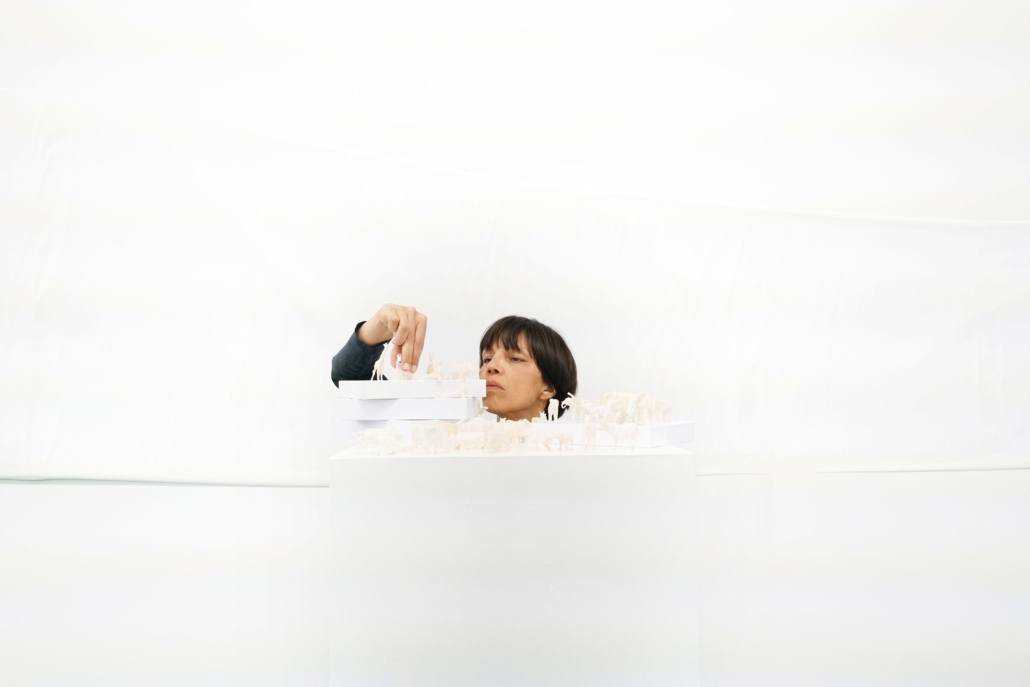
Photo von Helmut Gsöllpointner Jr.


WALKSCREEN
Interactive installations – or “walkscreens” –
are the artistic center of gravitation of the media artists Ruthe Zuntz
and Michael Reitz. Using the medium photography, they capture the spirit
of vibrant places and cultures and transfer their essence to a different
but corresponding place.
Since 1997 they create interactive environments making the visitor an
integral and active part, making him a wanderer in a virtual place.
His movements initiate the flow of pictures, visual codes and sound bites.
With dozens of remote sensors the room is reacting to every step, every
act of the body. That drags the visitor into the distant place, allowing
him to experience its very own vibrations of life and culture.
During Ruthe’s studies in New York (1996-97), she developed with
Michael a concept to share her passion for this melting pot with people
abroad. The first installation consisted of dozens of projectors, controlled
by remote sensors that sensed the movements of the visitors and made the
pictures in the exhibition change with every step. This concept allowed
the visitors to stroll around the virtual city. In 1997, “Moving
Images” was sponsored by the Akademie der Künste (Academy of
the Arts) and presented on 800sqm in Buch, Germany.
In 2000, they founded “walkscreen” as their artistic platform,
allowing them collaborations with both institutional and commercial partners.
Their projects include:
2005 point to point “Globalism and Localism”, a choreographic
and multimedia collaboration with dancersn from 21 countries on identity
and cultural exchange in Tokyo 2005 on behalf of the Asian European Foundation
ASEF
2004 Twentyfour Seven, Kiosk’s tiny windows allow only fragmentary
conversations from inside the kiosk to the outside worlds and vice versa.
People recognize each other by their small addictions: to news, to cigarettes,
alcoholic beverages, and chewing gum.
2003 What the Hell is Big City, Rome. Berlin. Tel-Aviv. New York. Same
same but different? The wandering of the modern nomad in a tryptichon
of urban culture.
2000 AgriCultura, The power of organic food presented in an overwhelming
600sqm barn, flooded by 45,000 photographs, reacting on every movement
of the visitors.
1998 Walkabout, With a unique look-around photography the visitor is pushed
into a pop-up picture book, finding himself in the maze of Berlin‘s
backyards of the old jewish quarter.
1997 Moving Images, 800 sqm interactive installation reviving New York‘s
dynamic, the permanent flow of images, stories and sound: The walkscreen
is born.
1996 Mind The Gap, Stage design for dance performance, New York, USA.
Additional projects have been:
2004 “Fashion City”, installation for the central plaza of
Igedo, the world’s biggest fashion
fair, Düsseldorf, Germany
2003 “Roaring Berlin”, opening show for the Hugo Boss Flagship
Store, Berlin
2000 “My (Projected) Lifetime”, Potsdam
1999 “Mind The Gap II”, Berlin, Germany
1999 “Labyrinth of the Ages”, Rome, Italy
1998 “100 years back yard” Exhibition design for the Museum
of Neukölln, Berlin
the concept behind WALKSCREEN
© Katja Bartholmess
The two media artists Ruthe Zuntz and Michael Reitz founded WALKSCREEN
in 2000. It is a company that focuses on a new way of art installations
and also serves as an artistic platform that allows the two artists to
collaborate with institutional, commercial, and artistic partners.
At the beginning, Ruthe and Michael had invented what they called “walkscreens”
– a unique form of interactive installations in which photography
and novel approaches to technology and engineering merge to create truly
spectacular experiences:
The two media artists continue to invent new ways – some of the
techniques are patented – of incorporating the visitor’s movement
into installations that capture the spirit of vibrant urban places and
transplant their essence to another place.
Ruthe and Michael capture the life of places and their inhabitants. They
take photographs, they interview people, and they record noises and sounds.
In short: They develop an intimate relationship with the people and the
places. They focus on details that may sometimes be small but that make
all the difference. Each photograph is a story in itself and part of a
bigger story at the same time. There is movement, there is light and shadow,
there is happiness and sadness, rhythm and quietude.
It is WALKSCREEN’s major concern to incorporate the visitor into
their art installations. WALKSCREEN installations are never about leaning
back and enjoying the movie. On the contrary: The visitors are crucial
to the installation. They become directors of the scenes and stories around
them. Not until they participate will the installation begin. Their movements
and their choices bring the stories to life. – Without the visitors
there would be a standstill.
One of the WALKSCREEN artists’ motivations is to see the visitors
emerge from their installation with shiny eyes and the conviction that
they have physically been where the story took them.
be part of the story with WALKSCREEN
Stories unfold in front of our eyes. Every minute of every day. Our eyes
absorb the images and send the information onto their way to our brain
where they turn into new stories; into OUR stories. We interpret what
we see; we charge what is visible with our emotions and our experiences.
The stories “walkscreen” focuses on are inseparably connected
with the places where they happen. Stories happen in real places and are
always influenced by their social, biological and urban surroundings.
But with “walkscreen” the visitors do not actually have to
be in a certain place to experience the place’s stories. The “walkscreen”
installations are designed to capture and reproduce certain aspects of
a place. Visitors can temporarily inhabit those places and experience
for instance the vastness and speed of New York or the slowness and mysteriousness
of Berlin.
WALKSCREEN projects
Moving Images Berlin New York (1997)
“Moving Images” moves New York to Berlin. The lively and always
hectic bundle of New York lifestyles, the irresistible New Yorkers, the
noise, the ever-present insomnia, the sometimes comforting and sometimes
inhumane anonymity are the focus of this project. And the aim of the project’s
result – a huge installation – is to capture the spirit and
to allow visitors to experience the speed and unpredictability of New
York.
It was Ruthe Zuntz’s aim to make the visitors experience what it
really means to be in New York. The photographs were a result of close
encounters and accidental meetings.
Each screen on the ground tells a unique chapter of the New York story.
One of the screens tells the story of dog parks, a place where only dogs
and their owners are allowed to go. – The visitor, presented with
a grid of screens that resembles streets and avenues, is the accidental
architect of a dynamic, colorful, ever-changing, and noisy version of
New York.
16 slide projectors project more than 1.000 photographs onto the ground,
covering an area of 600sqm. Each projector is equipped with a sensor that
responds to even the tiniest movements of the visitor who is walking upon
the photographs on the ground. With each movement a new photograph and
a new corresponding soundbite appears. The visitors have no control; all
they can do is walk around and render themselves to the pace of the city.
– Just like you have to when you want to become part of New York.
Walkscreen 1998
The walkscreen installation turns the viewer into an active visitor and
wanderer of cities. The visitors can immerse themselves in the structures
of the city as the displayed photographs change according to the visitors’
arm movements. With a simple gesture of the arm, the visitors can change
the perspective of the computer-animated city in front of them. The visitors
control the images; they are part of the images; and they are, ultimately,
part of the city. Illusion melts into reality.
Ruthe Zuntz photographed Neukölln, a part of Berlin that might be
compared to the Bronx in New York. She took photographs of shops that
had to close down because they could not generate a sufficient turnover
in the relatively poor area. The empty shop fronts and the streets around
them create a sense of desertion and loneliness. This installation focuses
on structures and the absence of people, another aspect of urbanity.
Thousands of photographs were the basis for a computer-animated version
of Berlin’s streets of blocks. Four bundled sensors placed overhead
gather every movement of the visitors’ arms and send the information
to a computer that controls the animations on display.
Walkabout 1998
In Berlin you have to dig a little deeper before you find the city’s
stories. While New York happens in the streets, Berlin takes place in
the backyards. – With a complex camera construction, developed by
WALKSCREEN for an effect we call look around photography, we shot series
of photographs in the backyards of Berlin’s historical center. A
place where history and stories are most intrinsically tied to one another.
The visitors could enter the virtual backyards at their own pace and with
full control of the speed with which the backyard stories unfold.
Ruthe Zuntz’s photographs are compositions of perceptions. She tells
12 exciting stories about different places and people in Berlin’s
Mitte district. With the different angles she uses – bird’s
eye view and worm’s eye view and everything in between – she
offer the visitor entirely new ways to access the stories. The visitors
turn into Lilliputs and Gullivers, towering above the scene in one second
and crawling on the ground in the next. The effect is that of a pop up
picture book: The reader of the story, the visitor, controls the speed
with which the pages turn and thus the pace with which the story unfolds.
The visitors walk into the 3D installation on an interactive carpet, equipped
with touch-sensitive sensors. With every step on the carpet the visitors
enter the backyards further. Corresponding soundbites complete the experience.
What the hell is a Big City? 2003
The nightlife area, the business district, the shopping street, the hip
quarters, the rich quarters – you can find them in New York, Berlin,
Rome, Tel Aviv as well as in every big city around the world. Contemporary
urban nomads can experience variations of corresponding parts of cities
wherever they go. This installation focuses on globalized perceptions
of cities. No-one needs to choose one favorite city anymore: You can take
the best out of each city and assemble the pieces to one city that’s
perfect just for you.
The visitors are presented with images of different cities shown on three
big screens. What appears is one city simultaneously made up of fascinating,
endearing, and unique details of New York, Berlin, Rome and Tel Aviv.
Everyone can take a leap and dive into what becomes one big subjective
city.
24/Seven 2004
The urban dweller needs a place that caters to his immediate needs, that
satisfies his little addictions. It doesn’t need to be fancy; it
just needs to always be there and to always be open. The kiosk provides
all this. It is the city organism’s smallest provisioning cell.
The vendors operate from inside the kiosk. Through the window that separates
them from their customers, they can see the outside world only in fragments.
The photo and video installation captures the kiosk owners’ perspective
and displays them as urban cutouts. The world of the kiosk takes center
stage and draws attention to an important feature of the urban environment.
The Gap 1996
In this installation, the visitor is once more the trigger for action.
But this time not a complicated sensor system but only the ability of
a solid body to cast a shadow is needed.
Ruthe Zuntz photographed scenes, objects, and pieces of writing and overlapped
them in a way that needed the visitor to uncover the stories. She wanted
the visitors to be able to write their own stories with the movements
of their bodies.
The very minimalist interactive technique crosses the channels of light
of two slide projectors and overlaps the projections. The result is a
window of light. If visitors move between the screens and the projectors,
they cast shadows of meaning onto the windows of light. Parts of photographs
and snippets of texts appear in the shape of the visitors’ shadows.
Diese Lecture findet im Rahmen des Projektes WAGE statt.